Tuesday, May 26, 2009

Saturday, May 23, 2009
Bernanke on the Difficulty of Economic Forecasting
Like weather forecasters, economic forecasters must deal with a system that is extraordinarily complex, that is subject to random shocks, and about which our data and understanding will always be imperfect. In some ways, predicting the economy is even more difficult than forecasting the weather, because an economy is not made up of molecules whose behavior is subject to the laws of physics, but rather of human beings who are themselves thinking about the future and whose behavior may be influenced by the forecasts that they or others make.
Tuesday, May 19, 2009
Economist Robert Frank on the Consumption Tax

...What's the solution in the financial world?
To start, you can regulate the amount of leverage asset managers could offer. But if you really want to blunt the incentive for investors to squeeze out ever higher returns, scrap the income tax and shift to a much more steeply progressive consumption tax. You would report people's income and savings to the IRS each year. The difference between those numbers is how much they consume.
Tax that instead of taxing people's income, and the government would strengthen the incentive to save and invest, and weaken the incentive to build bigger houses. If other people were building smaller houses, each investor would feel less compelled to take greater risks to keep up.
Wouldn't a consumption tax, which reduces consumer spending, be a drag on economic growth?
The tax should be phased in gradually after the economy recovers. The capital market would direct consumers' extra savings to investors, who would spend the money on capital goods. So total spending would remain the same - and it's total spending that determines output and employment.
Monday, May 18, 2009
The Heavy Hand of Energy Policy
The Obama administration aims to accelerate higher gas-mileage rules using the heavy handed approach. This idea is an easy sell to the public because the perception is that the automotive companies will bear the cost of the mandate, without realizing that the costs are passed on to the consumer. The same goals could be accomplished much more effectively and efficiently by using a simple gas tax as proposed by Greg Mankiw and his Pigou club.
Monday, May 11, 2009
Inflation and Zimbabwe
 |
- Milton Friedman
This from The Wall Street Journal about hyper-inflation in Zimbabwe. It seems they have solved the problem by adopting a stable currency: the U.S. Dollar.
Zimbabwe topped that record for economic mismanagement last year. The country’s annual rate peaked at 489 billion percent in September 2008, the International Monetary Fund reported, and for the full year averaged 56 billion percent. The Zimbabwe dollar became literally worthless, the IMF said, and by November 2008 it “virtually disappeared from circulation.”
Fed up, locals started using U.S. dollars, which put a sharp lid on inflation. This year, the IMF estimates that inflation will descend from hyper-stratosphere and average 6.9%, when measured in dollar terms.
Thursday, May 7, 2009
Labor Mobility and Unemployment
One reason the jobs misery index is so high: The housing bust has reduced Americans' mobility. The Census Bureau reported on Apr. 22 that the percentage of the population that moved was the lowest since recordkeeping began in 1948. Home-owners, the Census found, were only one-fifth as likely to move as renters.
Monday, May 4, 2009
Meltzer on Inflation and Deflation
When will it come? Surely not right away. But sooner or later, we will see the Fed, under pressure from Congress, the administration and business, try to prevent interest rates from increasing. The proponents of lower rates will point to the unemployment numbers and the slow recovery. That’s why the Fed must start to demonstrate the kind of courage and independence it has not recently shown.
Milton Friedman often said that “inflation was always and everywhere a monetary phenomenon.” The members of the Federal Reserve seem to dismiss this theory because they concentrate excessively on the near term and almost never discuss the medium- and long-term consequences of their actions. That’s a big error. They need to think past current political pressures and unemployment rates. For the next few years, they cannot neglect rising inflation.Thursday, April 30, 2009
Making Lemonade From Lemons
The U.S. economy shrank sharply in the first quarter, capping its worst six-month performance in 51 years, the government said Wednesday. But a large decline in inventories and an uptick in consumer spending suggest the economy is closer to the day when it resumes growing.
Federal Reserve Economic Forecast
Information received since the Federal Open Market Committee met in March indicates that the economy has continued to contract, though the pace of contraction appears to be somewhat slower. Household spending has shown signs of stabilizing but remains constrained by ongoing job losses, lower housing wealth, and tight credit. Weak sales prospects and difficulties in obtaining credit have led businesses to cut back on inventories, fixed investment, and staffing. Although the economic outlook has improved modestly since the March meeting, partly reflecting some easing of financial market conditions, economic activity is likely to remain weak for a time. Nonetheless, the Committee continues to anticipate that policy actions to stabilize financial markets and institutions, fiscal and monetary stimulus, and market forces will contribute to a gradual resumption of sustainable economic growth in a context of price stability.
In light of increasing economic slack here and abroad, the Committee expects that inflation will remain subdued. Moreover, the Committee sees some risk that inflation could persist for a time below rates that best foster economic growth and price stability in the longer term.
Socialism in the Classroom
An economics professor at Texas Tech said he had never failed a single student before but had, once, failed an entire class. That class had insisted that socialism worked and that no one would be poor and no one would be rich, a great equalizer. The professor then said ok, we will have an experiment in this class on socialism.
All grades would be averaged and everyone would receive the same grade so no one would fail and no one would receive an A. After the first test the grades were averaged and everyone got a B. The students who studied hard were upset and the students who studied little were happy. But, as the second test rolled around, the students who studied little had studied even
less and the ones who studied hard decided they wanted a free ride too; so they studied little..
The second test average was a D! No one was happy. When the 3rd test rolled around the average was an F.
The scores never increased as bickering, blame, name calling all
resulted in hard feelings and no one would study for the benefit of
anyone else.
All failed, to their great surprise, and the professor told them that
socialism would also ultimately fail because when the reward is great, the effort to succeed is great; but when government takes all the reward away; no one will try or want to succeed.
Could not be any simpler than that....
Monday, April 27, 2009
Index Investing, EconTalk, and John Bogle ... Hat Trick!
Friday, April 24, 2009
Bogle on Investing
Thursday, April 23, 2009
A Random Walk Down Wall Street
Investors in actively managed mutual funds for the past five years have reason to wonder what they have been paying for: A new study from Standard & Poor's finds that 70% of large-cap fund managers who use the S&P 500-stock index as a benchmark for comparison have failed to match the performance of the index over that time....The failure of active management is replicated across almost all categories, not only U.S. stock funds but also bond funds and even emerging-markets funds. What's more, those numbers are similar to the previous five-year cycle.
Thanks to Mankiw's blog for the link.
Wednesday, April 22, 2009
Health Care Markets
 |
In the current debate over rising health care costs, we market lovers cringe when we hear of government health care. The proponents of change say that the current market system is not working. I would agree. The problem is not with markets, but with the market conditions of health care. In order for markets to work effectively people must be aware of prices, there must be true competition, and consumers must bear the cost of their decisions. All these aspects of an effective market are missing for most health care consumers. This article contains this quote:
Ask most Americans how much it costs to visit a doctor and they probably do not know.
Ask doctors what their fees are and they're not likely to know that either.
Health care prices - both physician fees and prices of medical procedures - have been cloaked in mystery for decades.
Why I Dig Adam Smith...

I have been reading Adam Smith of late and have found it refreshing and disturbing at the same time. I have found it refreshing to read Smith's very clear descriptions of what makes the market system work, and also his clear defense of economic freedom. The disturbing part is not due to Smith or his arguments, but in the lack of progress that we in the business of economic education have made in conveying the ideas that Smith published in 1776 - ideas that are considered to be the bedrock of orthodox economics. Smith largely wrote in response to the merchantilist ideas of his day. We are still fighting a battle of ideas that have their roots in merchantilism. We have convinced the population that the world is round and germ theory, why is comparative advantage so difficult? I would enjoy your comments. The following is one of my favorite Smith quotes:
It is the maxim of every prudent master of a family, never to attempt to make at home what it will cost him more to make than to buy. The tailor does not attempt to make his own shoes, but buys them from the shoemaker. The shoemaker does not attempt to make his own clothes, but employs a tailor. The farmer attempts to make neither the one nor the other, but employs those different artificers. All of them find it for their interest to employ their whole industry in a way in which they have some advantage over their neighbors, and to purchase with a part of its produce, or what is the same thing, with the price of a part of it, whatever else they have occasion for.
What is prudence in the conduct of every private family, can scarce be folly in that of a great kingdom. If a foreign country can supply us with a commodity cheaper than we ourselves can make it, better buy it of them with some part of the produce of our own industry, employed in a way in which we have some advantage.
- Adam Smith
Wealth of Nations
Here and here are a couple of other posts on trade I made early in my blogging career on trade.
Monday, April 20, 2009
Go jump off a supply curve!
The new issue of BusinessWeek has a feature story: What Good Are Economists Anyway.
Economists mostly failed to predict the worst economic crisis since the 1930s. Now they can't agree how to solve it. People are starting to wonder: What good are economists anyway? A commenter on a housing blog wrote recently that economists did a worse job of forecasting the housing market than either his father, who has no formal education, or his mother, who got up to second grade. "If you are an economist and did not see this coming, you should seriously reconsider the value of your education and maybe do something with a tangible value to society, like picking vegetables," he wrote on patrick.net.
Take that, you pointy-headed failures! Go jump off a supply curve!
Of course predicting the future is always difficult, especially when it involves human behavior. To be fair, there were economists who spoke frequently about the unsustainable increase in housing values - the word bubble was used frequently. While no one really saw the extent to which the toxic mortgages would plug up the financial system, there were voices of concern about lending practices and the savings rate of individuals. As for the disagreements among economists, macroeconomics is a still developing field and the models have been refined dramatically since The Great Depression when it started to evolve out of microeconomics. I suspect that the next decade will see another stage in the evolution as this recession again refines the models.
A Change in Consumer Expectations...

The current issue of Time Magazine is about the "New Frugality" - being a truly frugal person (I'm a real cheapskate) I was drawn to the article. The part of the article quoted below caught my attention as a great example of a change in demand due to a change in consumer expectations. Consumers expect the current administration to change gun ownership laws, so people are buying - especially handguns. There is also hoarding behavior due to speculation of a future tax on handgun ammunition - can't find a box of 9mm or .357 magnum ammo anywhere. Here's the segment:
Jody Windschitl, 49, Missouri Valley, Iowa
Our sales are up about 33% this year compared with last. As an industry, they say it's the "Obama effect." We have never been in business when the Democrats are in office. We've been told that gun sales go through the roof, and they weren't kidding. We can't even get stuff. Ammunition has just dried up all over the country. Right now we're so busy, we've had to hire one person. People are afraid also of the Democrats' putting a ban on firearms — that's the biggest fear factor.
Dilbert

Economists too often use of phrases like "it depends" and "one the one hand...one the other hand" - this comic pokes good fun at this habit.
The Great Recession...?

More and more I am seeing the current recession referred to as a "Great Recession". It will be interesting to see if this label sticks. This is legendary Fed Chairman Paul Volcker using the term:
Former Federal Reserve Chairman Paul Volcker on Saturday warned that while the severity of the recession may be waning, the U.S. faces a “long slog” toward recovery.
Volcker also said that the Fed’s recent interventions into credit markets will inevitably lead to a review of the Federal Reserve Act, and urged patience in addressing financial regulation.
In comments to a Vanderbilt University ... Volcker said that while the current downturn isn’t like the Great Depression of the 1930s, “we’re in a Great Recession for sure.”
“It does look like rather a long slog in terms of recovery…though the rate of decline is going to slow,” Volcker said.
Friday, April 17, 2009
Vertical Integration and Derived Demand

More precisely, they’re saying that mining companies can adapt more quickly to market conditions than they could in the past, and the reason is the iron mining and steel industries have become “vertically integrated.” That is, mining companies have been folded into larger corporations that control multiple steps in the sequence from mining to the production of finished steel. Barry D. Lesar, St. Louis County’s inspector of mines, said that when demand for steel plummeted, mining companies in the region reacted quickly. Mines throughout northeastern Minnesota have sharply cut production. Since December, workers at Hibbing Taconite, Keewatin Taconite and Minntac in Mountain Iron — hundreds of workers in all — have been laid off. That’s the bad news. The good news, Lesar and others say, is that when the market for steel revives, those workers could be put back to work with equal speed.
Thursday, April 16, 2009
100 Trillion Dollar Note

I ordered a Zimbabwe 100 Trillion Dollar Note to use as an example of hyperinflation in class. How much? I bought the 100 Trillion Dollar note 0n Ebay for $5 + $1 shipping.
![[dilbert041609.gif]](https://blogger.googleusercontent.com/img/b/R29vZ2xl/AVvXsEi8beVWfQt-cviSG9T7q-f3lVhRhXcvI1I55bv716dsJ2cz2mj51ZTIihwpVPFQqyet11IAyg5cVGK_ChKjNio6IMnOjkVVqmpEXvUFk6gGi60xwin9ZaBN2dh43bXo4qK-8UEcsiacw-c/s1600/dilbert041609.gif)
Wednesday, April 15, 2009
Tax Day
 |
This story:
WASHINGTON – On the day of the deadline for Americans to file their tax returns, President Barack Obama will talk about restoring fairness to the tax code and providing tax relief to working families.
Of course "fairness" is a loaded word. I might consider fair to be smaller marginal rates for people who make under $100,000 and an increase in the teacher tax deduction. As long as we are at it, why not include a big tax credit for teachers who want to pursue more education - I might like to pursue a MBA or PhD. Of course scarcity means that in order to raise the same amount of revenue, a reduction in taxes for one household means a tax increase for someone else. The "tax relief to working families" would imply that President Obama is pursuing policy that would make the tax code more progressive - no real surprises there.
After doing my taxes again this year, I think tax simplification might be a more noble cause to pursue.
Update : It looks like President Obama is at least interested in tax simplification, according to this story:
Seeking to tap into public exasperation with the tax system, Obama said: "We need to simplify a monstrous tax code that is far too complicated for most Americans to understand, but just complicated enough for the insiders who know how to work the system."
"It will take time to undo the damage of years of carve-outs and loopholes. But I want every American to know that we will rewrite the tax code so that it puts your interests over any special interest. And we will make it quicker, easier and less expensive for you to file a return, so that April 15 is not a date that is approached with dread each year," he said.
Of course the difficulty of passing tax reform is monumental. Example - when President Bush's panel on tax reform suggested eliminating or reforming the mortgage interest tax deduction - the realtor's lobby group went wild and struck fear into the hearts of every homeowner.
Tuesday, April 7, 2009
What I Have in Common with Larry Summers
Upon the death of his hero, libertarian economist Milton Friedman, Summers wrote an Op-Ed in The New York Times entitled "The Great Liberator" arguing that "any honest Democrat will admit that we are now all Friedmanites." Summers wrote that while Friedman made real contributions to monetary policy, his real contribution was "in convincing people of the importance of allowing free markets to operate."
Monday, April 6, 2009
Fed Funds Rate 1990-2008

Alan Greenspan's time at the Fed was revered as the wonder years a few years ago when all the talk was about the "great moderation" - now the mantra is "too low for too long".
Bernanke part 1 & 2
Watch CBS Videos Online
Watch CBS Videos Online
Bernanke vowed to bring more transparency to the Fed. Watch this historic interview with a sitting Fed Chairman. Bernanke may well go down as our most powerful Fed chief to day.
Don't Forget to Invest in Human Capital
Taking the hot dog stand from Marketplace on Vimeo.
Chris Farrell reminds us that working can be healthy and that many people are going to end up working for a longer period of time than they had planned.
Sunday, April 5, 2009

Thursday, April 2, 2009
Monday, March 9, 2009
Friday, February 20, 2009
Mankiw and Blinder on Consensus
There are many jokes about economists not agreeing on policy, or giving an "it depends" answer. Greg Mankiw's textbook and blog lists some things that economists agree on:
I include a table of propositions to which most economists subscribe, based on various polls of the profession. Here is the list, together with the percentage of economists who agree:
- A ceiling on rents reduces the quantity and quality of housing available. (93%)
- Tariffs and import quotas usually reduce general economic welfare. (93%)
- Flexible and floating exchange rates offer an effective international monetary arrangement. (90%)
- Fiscal policy (e.g., tax cut and/or government expenditure increase) has a significant stimulative impact on a less than fully employed economy. (90%)
- The United States should not restrict employers from outsourcing work to foreign countries. (90%)
- The United States should eliminate agricultural subsidies. (85%)
- Local and state governments should eliminate subsidies to professional sports franchises. (85%)
- If the federal budget is to be balanced, it should be done over the business cycle rather than yearly. (85%)
- The gap between Social Security funds and expenditures will become unsustainably large within the next fifty years if current policies remain unchanged. (85%)
- Cash payments increase the welfare of recipients to a greater degree than do transfers-in-kind of equal cash value. (84%)
- A large federal budget deficit has an adverse effect on the economy. (83%)
- A minimum wage increases unemployment among young and unskilled workers. (79%)
- The government should restructure the welfare system along the lines of a “negative income tax.” (79%)
- Effluent taxes and marketable pollution permits represent a better approach to pollution control than imposition of pollution ceilings. (78%)
Unfortunately economists have varied success in convincing the public and politicians of what the research and consensus of economists say. In his book "Hard Heads, Soft Hearts" Alan Blinder, an economics prof at Princeton, writes of Murphy's law of economic policy:
"Economists have the least influence on policy where they know the most and are most agreed; they have the most influence on policy where they know the least and disagree most vehemently."


Tuesday, February 10, 2009
Becker and Murphy on Stimulus
![[Commentary]](https://lh3.googleusercontent.com/blogger_img_proxy/AEn0k_uElMBqw-7STWaWJYvl1T0MZjZQKwFGx2-TKvI16NGE8G3ZhL9ghC5hFXiP34-2W4EX17CwjInqALgkVjHLwrHPX03OTQwCA_1hdgiq8CifHhew4Tyt6ELlYUCO4R6SbwLS5WMzSwZBkd3yR8QZD0KHCw=s0-d)
Nobel Laureate Gary Becker and University of Chicago professor Kevin Murphy weigh in on the stimulus package:
Our own view is that the short-term stimulus from the legislation before Congress will be smaller per dollar spent than is expected by many others because the package tries to combine short-term stimulus with long-term benefits to the economy. Unfortunately, short-term and long-term gains are in considerable conflict with each other. Moreover, it is very hard to spend wisely large sums in short periods of time. Nor can one ever forget that spending is not free, and ultimately it has to be financed by higher taxes.
The whole article is worth a read.
Friday, February 6, 2009
Obama, Summers and the "Third Rail"

In a recent article, Time magazine describes the abilities and experience of Obama economic advisor Larry Summers. Summers is brilliant and tends to be a relatively mainstream economist who favors intervention where there is merit, but prefers to let markets forces work their "invisible hand" magic. The article also mentioned that the Obama administration is planning to take on Social Security and Medicare reform.
And then, perhaps as early as March, they'll launch their biggest lift with the beginnings of a plan to reform Social Security and Medicare, the two entitlement programs that, even before the economy collapsed, were threatening the Treasury with bankruptcy. By any standard, it is a massive three-month agenda fraught with political risk. The key to getting it all done, Summers says, is entering into a "compact" with the country "that this isn't just government as usual throwing money at things." When Obama unveils his annual budget in late February or March, Summers promises that the President "is going to describe the kinds of approaches he wants to take to the entitlement problems that have been ignored for a long time." Some options might include delaying retirement, stretching benefits and lifting the cap on taxable earnings. Could one of these prevail? "Remains to be seen," Summers says.
Thursday, February 5, 2009
Congress Wants a Trade War
![[Commentary]](https://lh3.googleusercontent.com/blogger_img_proxy/AEn0k_vToCUWKlpj-yRybdBm--r4w19NANwZe6tz8hIJnB5UlhKKaeS72rhC836U_H9AEe2N_QPOaVp8zvdiAt3O30Sed6NLvh0JJ5Rqju8tnqAPMm8ePXbCLzuQRAubD7jYPElUyl6BWEKHmPQbJLBhvPtA=s0-d)
The stimulus bill has everyone talking about the size, the mix of spending and tax cuts, and how soon the spending will actually enter the real economy. Economists debate the issues, but there is a growing concern about the protectionist policies in the bill. Burton Malkiel makes an effective argument for free trade.
Suppose that we did not allow free trade between the 50 American states. Citizens like me in New Jersey would be far worse off if we could not buy pineapples from Hawaii, wine and vegetables from California, wheat from Kansas, and oil from Texas and Louisiana while we sell pharmaceuticals to the rest of the country. The specialization that trade makes possible allows all of us to live better.
The situation is the same with respect to world trade. Both we and the Chinese are better off if we can import inexpensive clothing from China and sell them large-scale computers and data storage equipment.
Then he warns of fallout:
Hostility has been no less evident in Europe and China. The European Union has said that it will not stand by idly if the U.S. violates its trade agreements and its obligations to the World Trade Organization. The risks of retaliation and a trade war are very real.
Since the U.S. is the biggest exporter in the world, retaliation could cost America more jobs than the provision would create. It could also destabilize the global capital flows on which the U.S. depends to fund its deficits. Moreover, the provision could delay some shovel-ready infrastructure projects, since sufficient American-made materials may not be immediately available. The U.S. does not manufacture enough steel to meet domestic demand.
In 1930, just as the world economy was sinking as it is today, the U.S. Congress passed the Smoot-Hawley Tariff Act, which essentially shut off imports into the U.S. Our trading partners retaliated, and world trade plummeted. Most economic historians now conclude that the tariff contributed importantly to the severity of the world-wide Great Depression.
Monday, February 2, 2009
Dissent
Here is their statement:
Notwithstanding reports that all economists are now Keynesians and that we all support a big increase in the burden of government, we do not believe that more government spending is a way to improve economic performance. More government spending by Hoover and Roosevelt did not pull the United States economy out of the Great Depression in the 1930s. More government spending did not solve Japan's "lost decade" in the 1990s. As such, it is a triumph of hope over experience to believe that more government spending will help the U.S. today. To improve the economy, policy makers should focus on reforms that remove impediments to work, saving, investment and production. Lower tax rates and a reduction in the burden of government are the best ways of using fiscal policy to boost growth.
Friday, January 30, 2009
Opposition to the Stimulus Package
The economy shrank at a 3.8 percent pace at the end of 2008, the worst showing in a quarter-century, as the deepening recession forced consumers and businesses to throttle back spending.
Although the initial result was better than economists expected, the figure is likely to be revised even lower in the months ahead and some believe the economy is contracting in the current quarter at an even faster pace.
Meanwhile, criticism of the Fiscal Stimulus package is growing even as it appears it may pass both house and Senate easily. Here's what NY Times columnist David Brooks has to say about the package:But they’ve created a sprawling, undisciplined smorgasbord, which has spun off a series of unintended consequences. First, by trying to do everything all it once, the bill does nothing well. The money spent on long-term domestic programs means there may not be enough to jolt the economy now (about $290 billion in spending is pushed off into 2011 and later). The money spent on stimulus, meanwhile, means there’s not enough to truly reform domestic programs like health technology, schools and infrastructure. The measure mostly pumps more money into old arrangements.
Thursday, January 29, 2009
The Stimulus Package and Protectionism
Here's what ND Senator Byron Dorgan says:
"The 'Buy American' provision will help stimulate our own economy," Sen. Byron Dorgan, D-N.D., who wrote the provision, told CNNMoney. "When taxpayer dollars are used, we should urge that money to support the things produced here at home."
So why are Economists concerned? The infamous Smoot-Hawley bill passed in 1930 to protect American producers during the Great Depression serves as a classic reminder of what protectionism can do to an already struggling economy. Most economists believe the legislation only added to the depth and length of the depression. Here's what Wikipedia has to say:
The Smoot-Hawley Tariff Act (sometimes known as the Hawley-Smoot Tariff Act) was an act signed into law on June 17, 1930, that raised U.S. tariffs on over 20,000 imported goods to record levels. In the United States 1,028 economists signed a petition against this legislation, and after it was passed, many countries retaliated with their own increased tariffs on U.S. goods, and American exports and imports plunged by more than half. In the opinion of some economists, the Smoot-Hawley Act was a catalyst for the severe reduction in U.S.-European trade from its high in 1929 to its depressed levels of 1932 that accompanied the start of the Great Depression.
Notice the proud moment in history when 1,028 economists stood together against the bill. Unfortunately they were ignored.
Wednesday, January 28, 2009
The Economy and the Powell Doctrine
The "Powell Doctrine" is a journalist-created term, named after General Colin Powell in the run-up to the 1990-1991 Gulf War. ..asserting that when a nation is engaging in war, every resource and tool should be used to achieve decisive force against the enemy, minimizing US casualties and ending the conflict quickly by forcing the weaker force to capitulate.
So, $825 billion is like economic "shock and awe". Thanks to Wikipedia for the definition.
Tuesday, January 27, 2009

Monday, January 26, 2009
Mankiw on Fiscal Stimulus
Tuesday, January 20, 2009
Inauguration Day 2009
 |
Economist John M. Keynes wrote about the effect of "animal spirits" in respect to the economy. The Economist magazine defines animal spirits this way:
The colorful name that Keynes gave to one of the essential ingredients of economic prosperity: confidence. According to Keynes, animal spirits are a particular sort of confidence, "naive optimism".
One of the best gifts President Obama can give the economy is a confidence boost - an attempt to lift our animal spirits. Will the new President use his gift of rhetoric to inspire hope and confidence?
Sunday, January 18, 2009
Wheelan for Congress

It is typical when discussing wise public policy from the economic perspective, and the reasons that they do not often translate into legislation, to have a student ask why there are not more economists in Congress. I usually respond that a platform full of economic platitudes is not often a politically popular platform. For instance, it is often easier to earn votes by pressing for protection of American industry with trade barriers than to explain the benefits of free trade. It is often easier to earn votes by fighting for the common man by increasing in the minimum wage than to explain how the policy ends up hurting low skilled workers.
Well, one of our own is running for Congress. Charles Wheelan, formally of the Economist magazine and the author of Naked Economics (scary title, good book) is running for the Illinois seat vacated by Rahm Emanuel.
Here is his platform:
At a time of unique challenges to the global financial system, it is imperative to have members of Congress with a sophisticated understanding of economics.
Economic stimulus that includes government spending should be carefully designed to ensure that only projects that have social value are funded. Infrastructure projects, identified by an objective panel, that likely would have been pursued without special funds are good candidates. If there are insufficient projects meeting a high cost-benefit threshold, additional stimulus should come in the form of tax cuts.
Any mitigation of greenhouse gas emissions in the United States should be pursued through market mechanisms that raise revenue, which can be used to reduce the personal, corporate and/or payroll tax.
The U.S. should make long-term investments in human capital, particularly in early childhood education for low-income and disadvantaged children.
Congress should promote free trade and work to reduce trade barriers around the globe. The best way to deal with the political costs of trade and the economic dislocation caused by international competition is to create a meaningful safety net for displaced workers.
Tax reform is necessary to improve the equity, efficiency and simplicity of the tax code. A priority of tax reform should be a reduction in the number of special incentives that narrow the tax base, induce tax avoidance and increase compliance costs.
The U.S. must deal with the looming fiscal obligations created by our entitlement programs: Medicare, Medicaid, and Social Security. Our current economic situation justifies increased deficits now, but today's policy must be attentive to the need for fiscal balance over the next several decades.
Check out Wheelan's website, The Naked Economist. Also check out the website Economists for Wheelan. Thanks to the Mankiw site for the link.
Friday, January 16, 2009
In Defense of Sweatshops

We have discussed sweatshops and outsourcing in class in reference to labor markets and free trade. Of course trying to defend sweatshops is difficult, but one must look at the alternatives to see the benefits. Working in a sweatshop is often seen as climbing the ladder for many workers in developing nations. In fact NY Times columnist Nicholas D. Kristof makes the case that sweatshops may be the best hope for many people in developing nations. (Thanks to the Mankiw blog for the link)
The best way to help people in the poorest countries isn’t to campaign against sweatshops but to promote manufacturing there. One of the best things America could do for Africa would be to strengthen our program to encourage African imports, called AGOA, and nudge Europe to match it . . . among people who work in development, many strongly believe (but few dare say very loudly) that one of the best hopes for the poorest countries would be to build their manufacturing industries. But global campaigns against sweatshops make that less likely.
Wednesday, January 14, 2009
Mankiw on Government Spending
Tuesday, January 13, 2009
The TED Spread and thawing credit markets

In an earlier post I wrote about the TED spread as an indicator of problems in the credit markets. The TED spread measures the difference between LIBOR which is the rate that banks pay when they take a three month loan and the yield on a three month treasury bill. Because interest rates are an indicator of risk, the large spread in the numbers revealed an increase in percieved risk in bank lending. Bloomberg reports today that the TED spread is narrowing, meaning that credit markets are beginning to return to normal. Check out the current chart here. As the cost of bank lending recedes, the volume of loans should also return to near normal levels. An important point to realize is that this crisis was caused by too much lending, so we should not want the volume of loans to return to pre-crisis levels.
Friday, January 9, 2009
Tell Me How You Really Feel

A visual history of the minimum wage. The light blue shadow shows the inflation adjusted minimum wage.
Students, now that you have debated the minimum wage as a public policy, tell me how you really feel about it. Click on the comment link below and leave your opinion. Be sure to support your opinion with clear reasoning. Also post a response to someone else.
Visual Guide to General Motors' Financial Woes

Gotta love these visual guides. Thanks to Flowing Data.

Tuesday, January 6, 2009
The Candlemaker's Petition

Monday, January 5, 2009
Expansionary Fiscal Policy
Remember, GDP = C + I + G + (X - M)
C = tax cuts for consumers should boost consumer spending
I = tax cuts for business should boost investments spending
G = infrastructure spending is an increase in "G"
(X - M) = the weak dollar should help net exports
Read this article from The Wall Street Journal for the full story on planned tax cuts.
Saturday, January 3, 2009
The Fed's Battle Plan


The Federal Reserve has learned from the past and is taking on the current economic crisis in an aggressive fashion. Fed Chairman Ben Bernanke is one of the nation's foremost scholars on the Great Depression and is using his expertise to head off the threat of deflation. The fear on the flipside is inflation. All the extra liquidity being pumped into the system may cause inflation to spike as the economy comes out of the current recession. While this is a legitimate fear, pulling the economy out of the current crisis is what is necessary in the short run.
Here's what Business Week has to say out the Fed's current battle plan:
Will the new battle plan work? Most likely yes—eventually. The Fed's monetary weaponry, in combination with the fiscal artillery of the incoming Obama Administration, are so potent that if they are used to their full extent they can almost certainly generate an economic recovery, potentially starting in the second half of 2009. The problem is that today's all-out attack on recession may well generate a surge of unwanted inflation in 2010 or after. But the Fed seems to regard that as an acceptable price to pay to avoid disaster now...
Most economists think that inflation is the last thing the Fed needs to worry about right now. According to New York University economist Mark L. Gertler, who collaborated with Bernanke on research during the Fed chief's Princeton years: "We are in an incredibly dangerous situation. Now is the time to be aggressive. There's no danger of inflation. It's almost insane that people are talking about it now." Even with all the Fed's heroic measures, predicts Merrill Lynch (MER) senior economist Drew Matus, "the recession is going to be a long one, and the recovery is not going to be a big one."
One reason for optimism—mild optimism, anyway—is that Bernanke has learned from the mistakes committed by the Fed during the Depression and the Bank of Japan during that nation's Lost Decade of the 1990s. In 1999, when he could afford to be undiplomatic, Bernanke asked in a book he contributed to whether Japan's monetary policy was "a case of self-induced paralysis," and he praised President Franklin D. Roosevelt's "willingness to be aggressive and to experiment."
Monday, December 29, 2008
Friday, December 19, 2008
Bailouts and Moral Hazard
Moral hazard is the prospect that a party insulated from risk may behave differently from the way it would behave if it were fully exposed to the risk. Moral hazard arises because an individual or institution does not bear the full consequences of its actions, and therefore has a tendency to act less carefully than it otherwise would, leaving another party to bear some responsibility for the consequences of those actions.
The problem with bailouts: If the expectation is created that the government will bail out firms experiencing economic hardship, they will pursue riskier opportunities than they would otherwise. Of course there is no free lunch, taxpayers end up bearing the cost burden of the now risk enhanced behavior.
Thursday, December 18, 2008

Friday, December 5, 2008
Extreme Losses
Recession: Deep and Wide
Thursday, December 4, 2008
Pigou Club, Hibbing Chapter
Do you support the idea of raising the gasoline tax by $1 over ten years?
What should the tax revenues be used for?
Should the tax be revenue neutral? (This means the new revenue would offset the revenue government receives from other taxes, resulting in no net tax increase on the American people)
Is this a good time to raise the gas tax? The chart below shows average U.S. gas prices over the previous twelve months. Notice the price of gas in Canada. The gap between the two lines represent the difference in the gas tax.

Defend your decision to support or oppose an increase in the gas tax using economic reasoning.
Update: China has bravely announced an increase in its gas tax. Read the full story here. It may interest you to see that it is being offset by reductions of fees and taxes elsewhere and being imposed during a slowing economy. Of course, the Chinese political system makes a tax increase an easier task.
Wednesday, December 3, 2008
The Paradox of Thrift
The paradox of thrift (or Paradox of Saving) is a paradox of economics propounded by John Maynard Keynes. The paradox states that if everyone saves more money during times of recession, then aggregate demand will fall and will in turn lower total savings in the population. One can argue that if everyone saves, then there is a decrease in consumption which leads to a fall in aggregate demand and thus leads to a fall in economic growth.
Game theory reasoning can also be applied where saving is the dominant strategy.
Monday, December 1, 2008
It's Official: Recession
The NBER — a private, nonprofit research organization — said its group of academic economists who determine business cycles met and decided that the U.S. recession began last December... Many economists believe the current downturn will last until the middle of 2009, and will be the most severe slump since the 1981-82 recession.
I.O.U.S.A.
Thursday, November 20, 2008
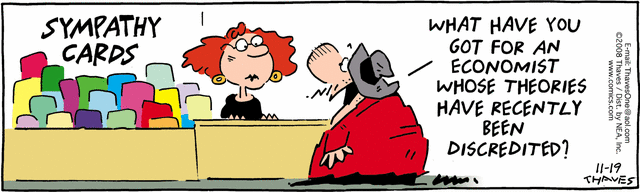
Frank and Earnest
Tuesday, November 18, 2008
![[hc081117.gif]](https://blogger.googleusercontent.com/img/b/R29vZ2xl/AVvXsEguhBF0UCYZhGsjBCcx8u-YXE2kjyaJo-iG9nCcNAAyfm1R15wuYgsN9mqI9pnvTT3N7x6tQqGImHVCf2FDJ1zG4y6ztgM0LI7-8W1fMtUq2NAZQmnwSw3AlSGt6YK4OJZeX5UG1ZW_pMw/s1600/hc081117.gif)
Monday, November 17, 2008

Why Isn't GM Competitive?
![[big3a.jpg]](https://blogger.googleusercontent.com/img/b/R29vZ2xl/AVvXsEiohyphenhyphenmRn7KNaWzOeaJf0UNOBhxe_fFykfrbPa_kG6BdZ2M4EnZDH_wRRt5XSCWU40sL6mQSGeD9xOTFFIFhGPIWyMiLlu1ZLsbCFwuETq8Kce-4vPLCjkHPSWkv6AJ5LD0rlNs6lm3MvVg/s1600/big3a.jpg)
On his Blog, Nobel Laureate Economist Gary Becker explains the lack of competitiveness by GM not because of the skill level of American workers, but large differences in cost structure. In his words:
Nevertheless, I believe bankruptcy is better than a bailout for American consumers and taxpayers. The main problem with American auto companies is that during the good times of the 1970s, 1980s and 1990s, they made overly generous settlements with the United Auto workers (UAW) on wages, pensions, and health benefits. Only a couple of years ago, GM was paying $5 billion per year in health benefits to retirees and current employees because their plans had wide health coverage with minimal co-payments and deductibility on health claims by present and retired employees. In those days, the UAW was one of the most powerful unions in the US, and it bargained aggressively with the auto manufacturers, carrying out strikes when its demands were not met. When the American auto industry began to face tough competition from Japanese and German carmakers, they were saddled with excessive pay to their workers, and vastly excessive pensions and health benefits to their current and retired workers.
It is not that cars cannot be produced profitably with American workers: the American plants of Toyota and other Japanese companies, and of German auto manufacturers, have been profitable for many years. The foreign companies have achieved this mainly by setting up their factories in Southern and border states where they could avoid the UAW, and thereby introduce efficient methods of production. Their workers have been paid well but not excessively, and these companies have kept their pension and health obligations under control while still maintaining good morale among their employees. In recent years GM and the other American manufacturers have chipped away at their generous fringe benefits, but their health and retirement benefits still considerably exceed those received by American auto workers employed by foreign companies. As a result of lower costs, better management, and less hindrance from work rules imposed by the UAW, about 1/3 of all cars produced in the US now come from foreign owned plants.
Thursday, November 13, 2008
More on Education
The most effective anti-poverty program we could devise for the long run would have less to do with income redistribution than with ensuring that poor kids get a first-rate education, from preschool on. One recent study found that if American students did as well as those in several Asian countries in math and science, our economy would grow 20 percent faster.
So let’s break for a quiz: Quick, what’s the source of America’s greatness?
Is it a tradition of market-friendly capitalism? The diligence of its people? The cornucopia of natural resources? Great presidents?
No, a fair amount of evidence suggests that the crucial factor is our school system — which, for most of our history, was the best in the world but has foundered over the last few decades. The message for Mr. Obama is that improving schools must be on the front burner.Saturday, November 8, 2008
To Barack Obama, From Mankiw
Listen to your economists. During the campaign you assembled an impressive team of economic advisers from the nation’s top universities, including Austan Goolsbee from University of Chicago and David Cutler and Jeff Liebman from Harvard. Your campaign’s director of economic policy, Jason Furman, is a smart, sensible, and well-trained policy economist. I know: He is a former student of mine.
Pay close attention to what they have to say. They will often give you advice quite different from what you will hear from congressional leaders Nancy Pelosi and Harry Reid. To make sure you hear the views of your economists, put them in offices close to yours. Tell your chief of staff to invite them to all the relevant meetings.
Wednesday, November 5, 2008
![[Obama-superman.jpg]](https://blogger.googleusercontent.com/img/b/R29vZ2xl/AVvXsEh3vnPXUOjUySKNgrQN-Yl88acEEvaCb66kJi1tjEAkxkdl7Uvd76L9oGg5iEZ8w7q8gF0giJPANmmEvl4RcGTs7hMxX-RsIv2gqEsCWnK1N0QDhltjQ5Dw5a3C1qA5rf7xJuhzQsew710/s1600/Obama-superman.jpg)

Tuesday, November 4, 2008
End Adolescence?
In math and science learning, which are among the most important indicators of future prosperity and strength, America lags far behind such emerging powers as China and India. Studying to compete with Asian counterparts in the world market is going to keep U.S. teens busier than anyone ever imagined. This will require year-round learning, with mentors available online, rather than our traditional bureaucratic model of education. But we must go further, toward a dynamic, real-world blueprint for learning.
Indeed, going to school should be a money-making profession if you are good at it and work hard. That would revolutionize our poorest neighborhoods and boost our competitiveness.
The fact is, most young people want to be challenged and given real responsibility. They want to be treated like young men and women, not old children. So consider this simple proposal: High school students who can graduate a year early get the 12th year's cost of schooling as an automatic scholarship to any college or technical school they want to attend. If they graduate two years early, they get two years of scholarships. At no added cost to taxpayers, we would give students an incentive to study as hard as they can and maximize the speed at which they learn.
Once we decide to engage young people in real life, doing real work, earning real money, and thereby acquiring real responsibility, we can transform being young in America. And our nation will become more competitive in the process.
Should Everyone Vote?
Tax Policy Reminder From Abe
Why America Needs an Economic Strategy
A final strategic failure is in many ways the most disconcerting. All Americans know that the public education system is a serious weakness. Fewer may realize that citizens retiring today are better educated than the young people entering the workforce. In the global economy, just being an American is no longer enough to guarantee a good job at a good wage. Without world-class education and skills, Americans must compete with workers in other countries for jobs that could be moved anywhere. Unless we significantly improve the performance of our public schools, there is no scenario in which many Americans will escape continued pressure on their standard of living.
Monday, November 3, 2008
Economists for _______________.
Tuesday, October 28, 2008
Will China and India Dominate the 21st Century?
Thursday, October 23, 2008
Helicopter Ben to the Rescue
Wikipedia explains how Helicopter Ben got his nickname via Milton Friedman:
In 2002, when the word "deflation" began appearing in the business news, Bernanke gave a speech about deflation. In that speech, he mentioned that the government in a fiat money system owns the physical means of creating money. Control of the means of production for money implies that the government can always avoid deflation by simply issuing more money. (He referred to a statement made by Milton Friedman about using a "helicopter drop" of money into the economy to fight deflation.) Bernanke's critics have since referred to him as "Helicopter Ben" or to his "helicopter printing press".
Wednesday, October 22, 2008
Where to Invest
Tuesday, October 21, 2008
Buffet Says its Time to Buy U.S. Stocks
Over the long term, the stock market news will be good. In the 20th century, the United States endured two world wars and other traumatic and expensive military conflicts; the Depression; a dozen or so recessions and financial panics; oil shocks; a flu epidemic; and the resignation of a disgraced president. Yet the Dow rose from 66 to 11,497.
You might think it would have been impossible for an investor to lose money during a century marked by such an extraordinary gain. But some investors did. The hapless ones bought stocks only when they felt comfort in doing so and then proceeded to sell when the headlines made them queasy.
Today people who hold cash equivalents feel comfortable. They shouldn’t. They have opted for a terrible long-term asset, one that pays virtually nothing and is certain to depreciate in value. Indeed, the policies that government will follow in its efforts to alleviate the current crisis will probably prove inflationary and therefore accelerate declines in the real value of cash accounts.
Equities will almost certainly outperform cash over the next decade, probably by a substantial degree. Those investors who cling now to cash are betting they can efficiently time their move away from it later. In waiting for the comfort of good news, they are ignoring Wayne Gretzky’s advice: “I skate to where the puck is going to be, not to where it has been.”Wednesday, October 15, 2008
Who should you vote for?
Thursday, October 9, 2008
Tragedy of the Commons
Credit Crisis Explained
AIG and Credit Default Swaps
Wednesday, October 8, 2008
Bailout Analogy
The Fire Next Time
Here's the best analogy I can offer. Suppose a guy down the street has been smoking in bed for the last 20 years. That's a stupid, irresponsible thing to do, and lots of people have told him so.
He just happens to live next to another idiot who stores containers of gasoline in his garage. He, too, ought to be fully aware that this is a foolish thing to do.
Predictably enough, the guy smoking in bed starts a fire that explodes in force when it hits the gasoline-filled garage next door. Now there's a hell of a blaze going on. If these two guys lived alone in a remote area of rural Montana, we wouldn't have much to discuss. But they don't. Instead, the fire is spreading down their residential suburban street, burning houses where nobody smokes in bed or keeps gasoline in the garage.
Damage Control
That's about where we are right now with the financial crisis. The question isn't whether we should rush to save the morons responsible and put ourselves at risk in the process. We shouldn't. The question is whether we should intervene to save the rest of the neighborhood. We should.
The fire department may end up helping our smoker and gas-can man just because it's an unavoidable part of fighting the larger fire. That's unfortunate, but it's not a good reason to call off the fire department. I don't get enough utility out of standing amid the smoldering ruins of their houses to justify the risk that the same thing may happen to my house a few hours later.
If you want to fine these guys, or put them in jail, or take away what's left of their property -- fine. That seems perfectly appropriate. But just make sure you take care of the fire first, because that's what's dangerous here.